
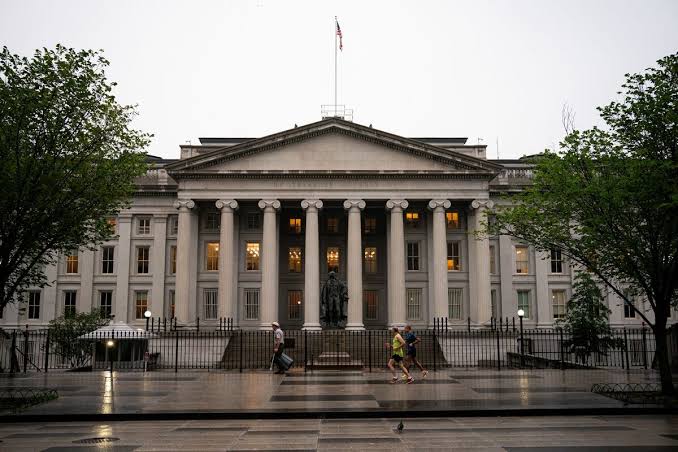
Source: BBC
US 10-Year Treasury Yield Hits Highest Level Since 2023 as Global Bond Rout Deepens.
The yield on the U.S. government's 10-year Treasury note has climbed to its highest level since November 2023, as a broad sell-off in global government bonds pushes borrowing costs higher and revives concerns about inflation, interest rates and mounting public debt.
The benchmark yield briefly reached 4.817% on Wednesday, September 2, before easing back. This move follows as investors continue to sell longer-dated government debt, demanding higher returns as the outlook for inflation and monetary policy becomes less certain.
The rise in the U.S. is part of a much wider move across global bond markets.
Japan's 10-year government bond yield has risen above 3% for the first time since 1996, while Britain's 10-year gilt yield has moved above 5.2%, its highest level since 2008. Germany's 10-year borrowing costs have also reached their highest level in about 15 years.
The immediate pressure is coming from a familiar combination of inflation fears and expensive government borrowing, but the latest bond sell-off has been intensified by the conflict in the Middle East.
Oil prices have risen sharply as fighting involving the United States and Iran threatens energy supplies and raises concerns about disruption around the Strait of Hormuz. Brent crude has been trading around $95 a barrel, reviving fears that higher energy costs could keep inflation elevated.
For bond investors, this creates a difficult calculation. If inflation stays high, central banks have less room to cut interest rates and may even have to raise them. Investors consequently demand higher yields from longer-term bonds to compensate for the risk that their returns will lose value to inflation.
There is another problem: governments are borrowing heavily at the same time.
U.S. federal debt has passed $40 trillion, while governments across major economies continue to run large deficits. The supply of new government bonds is therefore growing just as investors are becoming more cautious about holding long-term debt.
The technology sector is adding to that competition for capital. Major technology companies have issued large amounts of debt to finance the expansion of artificial intelligence infrastructure, including data centres and computing capacity. That means governments and corporations are increasingly competing for the same pool of global savings.
The 10-year Treasury matters because its influence extends well beyond the United States.
It is one of the world's most important reference rates, helping determine the cost of borrowing for households, companies and governments. When its yield rises, financial markets around the world tend to reprice risk and borrowing costs accordingly.
For emerging economies, the consequences can be particularly uncomfortable. Higher U.S. yields can make American government debt more attractive relative to riskier assets in developing markets, potentially encouraging investors to move money towards dollar-denominated assets. That can put pressure on emerging-market currencies and raise the cost of borrowing in international markets.
India, for example, has already seen its 10-year government bond yield move above 7% during the current global sell-off, as higher U.S. yields and rising oil prices weigh on investor sentiment.
The pressure is also reaching financial markets beyond bonds. Higher yields make government debt more attractive relative to riskier assets and can increase the cost of financing for companies. Technology firms that have borrowed heavily to fund the artificial intelligence boom are particularly exposed if the cost of debt continues to rise.
For the U.S. Treasury market, investors are now watching the 5% level closely.
A sustained move above 5% would mark a significant increase in the cost of long-term government borrowing and could put further pressure on stocks, corporate debt and government finances. The 10-year yield came close to that threshold this week before retreating.
The bond market's message is therefore broader than the movement of a single interest rate.
For much of the past decade, governments and companies operated in an era of unusually cheap money, supported by low interest rates and aggressive central-bank intervention. That environment allowed borrowing to expand rapidly and pushed investors towards riskier assets in search of better returns and the current sell-off suggests that period is becoming harder to sustain.
Inflation has not disappeared, governments need to borrow more and the energy markets are being disrupted by war. Meanwhile, central banks are once again facing pressure to keep monetary policy tight.
For now, markets are watching oil prices, inflation data, government debt issuance and the Federal Reserve's next policy decision. If those pressures remain in place, the world may be heading into a period where borrowing is simply more expensive than businesses, governments and consumers have become accustomed to.
The significance of the 10-year Treasury yield approaching 5% is not that the number itself represents a crisis. It is that the cost of money is rising at a time when the world has never had more debt to finance.

 Noble Nigeria

© Noble Nigeria. All Rights Reserved || Privacy Policy and User Agreement