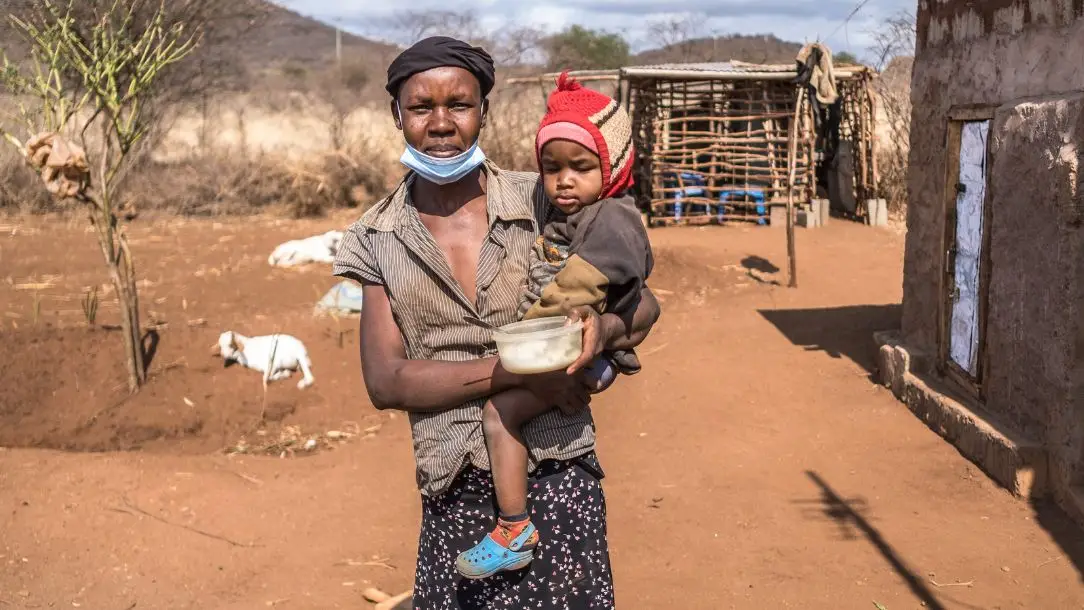
Source: BBC
Africa Is Now the World’s Hunger Hotspot as 645 Million People Go Hungry.
A new global assessment shows hunger declining for a third consecutive year, but Africa is moving in the opposite direction in absolute numbers, leaving the continent at the centre of a crisis that falling global figures can obscure._
Africa recorded an estimated 309 million people facing hunger in 2025, surpassing Asia’s 292 million and making the continent the region with the largest number of hungry people worldwide, according to the United Nations’ 2026 State of Food Security and Nutrition in the World report.
Globally, the number fell to about 645 million, or 7.8 per cent of the world’s population, from 8.1 per cent in 2024 and 8.6 per cent in 2022. The improvement represents roughly 14 million fewer people facing hunger than the previous year. But the global decline conceals a growing concentration of the problem in Africa, where population growth means that a modest fall in the prevalence of hunger does not necessarily translate into fewer people affected.
The distinction is noteworthy. A global average can improve even while a region carries an increasingly heavy share of the crisis. Africa’s estimated hunger prevalence edged down from 20.3 per cent in 2024 to 20 per cent in 2025, yet the continent still accounted for the largest number of people unable to obtain enough food.
The report also found that approximately 2.1 billion people worldwide experienced moderate or severe food insecurity in 2025. That is about one in four people globally. The figure has declined from 27.1 per cent in 2024, but the burden remains sharply uneven: 56.6 per cent of Africa’s population experienced moderate or severe food insecurity, compared with 20.3 per cent in Asia.
Food insecurity covers a wider range of experiences than hunger alone. It includes people who cannot reliably obtain sufficient, safe and nutritious food, even when they are not consistently going without meals. The report estimated that 2.69 billion people could not afford a healthy diet, underscoring the difference between food being available in a market and households being able to buy what they need.
For African households, it is central to understanding why hunger persists despite efforts to increase food production. The cost of food, household incomes, conflict, climate-related shocks and disruptions to trade can all determine whether food reaches a family’s table. When several pressures converge, families may reduce meal sizes, buy less nutritious food or spend money on food at the expense of healthcare, education and other essentials.
Nigeria faces these pressures within its own food system. In February 2026, the Food and Agriculture Organization launched an emergency and resilience plan for Nigeria, warning of a deepening food crisis and projecting that 34.7 million people could face crisis-level or worse acute food insecurity by mid-2026. That projection concerns acute food insecurity over a defined period; it should not be confused with the global report’s measure of chronic undernourishment. Together, however, the assessments point to the scale of the challenge facing households and the institutions responsible for responding to it.
The consequences extend beyond whether people eat enough today. Persistent food insecurity can undermine children’s nutrition and development, reduce their ability to learn, weaken workers’ productivity and leave families less able to withstand the next rise in prices or loss of income. For governments, it places pressure on public health, social protection and emergency assistance at a time when resources are already contested.
The global figures offer some grounds for cautious optimism, but they also expose the distance between progress and the international goal of ending hunger by 2030. The UN report projects that between 510 million and 520 million people could still face hunger at the end of the decade, with approximately 56 per cent of them in Africa.
That projection is a warning against treating a fall in the worldwide rate as evidence that the crisis is close to being solved. Progress will depend on whether countries can make nutritious food affordable, strengthen the resilience of farming and supply chains, respond to conflict and climate shocks, and direct assistance towards households most at risk.
As the world marks World Food Day on 16 October under the theme “Innovate Today, Nourish Tomorrow”, the central test is not simply whether global hunger continues to decline. It is whether that progress reaches the places where the burden is greatest, and whether families can afford the food they need without sacrificing other essentials.
For Africa, the latest figures make the challenge unmistakable: the world is making progress against hunger, but the continent is carrying a growing share of what remains.

 Noble Nigeria

© Noble Nigeria. All Rights Reserved || Privacy Policy and User Agreement