Source: BBC
American Forces Disable Cargo Ship in Gulf of Oman as Naval Blockade Tightens.
Washington says the St Kitts-flagged vessel ignored repeated warnings after visiting an Iranian port, as the US expands its campaign to restrict Tehran's access to international trade routes and military supplies.
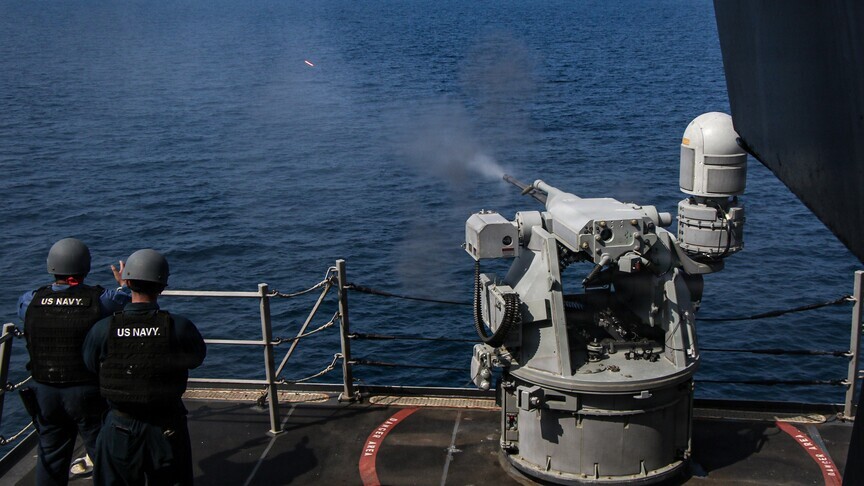
American forces have fired precision-guided munitions at a commercial cargo ship in the Gulf of Oman, disabling the vessel after its crew allegedly ignored repeated warnings to comply with the United States' naval blockade of Iran.
The ship, identified as the M/V Huda, was struck on Saturday, November 7, by a US military aircraft targeting its stern, according to the United States Central Command (CENTCOM). The vessel was reportedly attempting to leave regional waters after making a port call in Iran.
CENTCOM said its forces had instructed the civilian crew to abandon the sections of the vessel targeted before the aircraft carried out the strike. The operation disabled the ship without CENTCOM providing details about the crew's condition or the extent of the damage.
The incident represents another direct use of American military force against commercial shipping connected to the enforcement of its restrictions on Iranian maritime trade. It also illustrates how commercial vessels are increasingly exposed to the confrontation between Washington and Tehran.
In its November 7 statement, CENTCOM said American forces had redirected 147 commercial vessels that complied with blockade orders since July, while five merchant ships that refused to comply had been disabled. The command also said it had previously destroyed 10 Iranian commercial oil tankers allegedly connected to a multibillion-dollar shadow network operated by Iran's Islamic Revolutionary Guard Corps (IRGC).
The latest operation comes as Washington intensifies efforts to prevent Iran from generating revenue through oil exports and accessing materials that could support its military capabilities.
According to CENTCOM, the naval blockade has prevented Iran from exporting more than $25 billion worth of crude oil. The figure represents the American military's assessment of the financial impact of its enforcement campaign, rather than an independently established estimate.
The maritime operation was accompanied by another expansion of the American pressure campaign. CENTCOM announced the establishment of Task Force Iron Gate, a new unit intended to restrict Iran's ability to move advanced weapons systems, dual-use technologies, sanctioned materials and revenue through its land borders and the Caspian Sea.
The task force, ordered by CENTCOM commander Admiral Brad Cooper, will coordinate with other US government agencies to extend restrictions beyond the maritime blockade. Its creation signals Washington's intention to target not only Iran's access to international shipping but also the alternative routes through which Tehran could sustain its military and economic networks.
Iran, however, has rejected the prospect of being economically isolated through American military pressure. A spokesperson for the Islamic Revolutionary Guard Corps dismissed the new American initiative as ineffective, arguing that Tehran maintains close communication with neighbouring countries and has made preparations to counter restrictions on its trade routes.
The maritime confrontation has also raised fresh concerns about the safety of other commercial vessels operating in the region. Iranian state media reported on Sunday that two oil tankers caught fire after allegedly striking naval mines while attempting to navigate what Iranian authorities described as an unauthorised route through the Strait of Hormuz. The circumstances surrounding the reported explosions have not been independently established.
The developments are unfolding against the backdrop of an increasingly dangerous standoff between the two countries. US President Donald Trump has threatened further military action against Iran, while Tehran has warned of retaliation against infrastructure across the Gulf region.
The Strait of Hormuz remains central to the confrontation. Before the conflict, approximately one-fifth of global oil supplies passed through the strategic waterway, making restrictions on shipping there a concern far beyond the immediate parties to the dispute.
For countries dependent on imported petroleum, including Nigeria's trading partners, prolonged disruption could translate into higher energy costs, more expensive shipping and renewed pressure on international commodity markets. The extent of any eventual impact will depend on how long the confrontation persists and whether commercial shipping can continue safely through alternative routes.
For now, the disabling of the M/V Huda marks another escalation in Washington's campaign against Iran's maritime trade. With the United States extending its restrictions to land routes and the Caspian Sea, and Iran warning against cooperation with American forces, the confrontation is becoming increasingly difficult to contain within the waters surrounding the two countries.

 Noble Nigeria

© Noble Nigeria. All Rights Reserved || Privacy Policy and User Agreement