Source: BBC
Mercedes-Benz Freezes Domestic Investment as Factory Closures Loom
The German luxury automaker suspends further investment at its domestic manufacturing facilities after failing to reach an agreement with workers over production costs, raising concerns about jobs and the future of Germany's automotive industry._
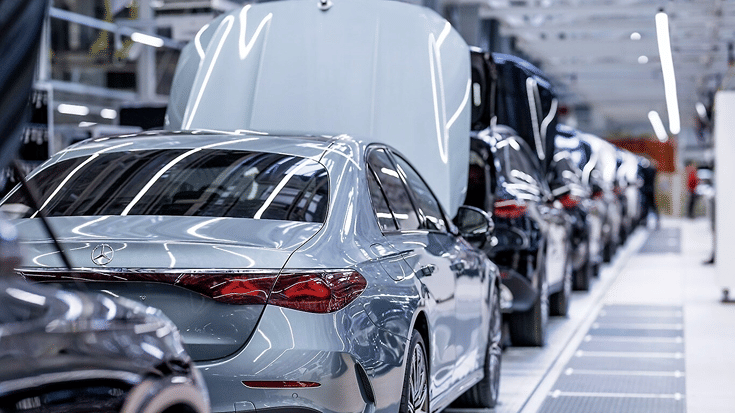
Mercedes-Benz, one of Germany's most recognisable industrial brands, has suspended further investment in its domestic manufacturing facilities while considering the possibility of closing some of its factories. The decision, announced on Thursday, November 12, 2026, follows unsuccessful negotiations between the company's management, its works council and IG Metall, Germany's largest industrial trade union, over proposed reductions in production costs.
The company's production chief, Michael Schiebe, announced the decision in an internal communication to employees, explaining that the existing cost structure made further investment in German facilities economically difficult. Management board member Britta Seeger also confirmed that the company was examining which of its domestic manufacturing locations it could continue to afford. Although Mercedes-Benz maintains that it wants to avoid factory closures, Seeger acknowledged that the possibility must now be considered more seriously.
The disagreement centres largely on labour costs and working conditions. Mercedes-Benz has been pushing for employees to work longer hours without corresponding increases in wages, with proposals including an increase in the working week from 35 to 40 hours. Management is also seeking reductions in additional employee benefits and other expenses. The company argues that its German production costs are becoming increasingly difficult to sustain against international competitors. According to Schiebe, the cost of a production worker's hour in Germany can be as much as five times higher than at some facilities in Eastern Europe.
However, the proposals have encountered resistance from workers' representatives and IG Metall, which considers the 35-hour working week a major achievement in Germany's industrial labour agreements. The union is also involved in wider wage negotiations in the country's metal and electrical industries, where it is seeking a five per cent pay increase. The disagreement has left negotiations over Mercedes-Benz's proposed productivity improvements without a clear resolution.
The company's difficulties extend beyond its domestic labour arrangements. Mercedes-Benz has experienced declining sales and profitability amid intensifying competition in the international automobile market. China, historically its largest individual market and responsible for approximately a third of its passenger-car sales, has become a particularly difficult market for the German manufacturer. Its sales in the country declined by approximately 19 per cent in 2025 as domestic Chinese brands strengthened their position, particularly in the electric vehicle segment.
The transition to electric mobility has also created financial pressures. Mercedes-Benz invested heavily in developing electric vehicles, but consumer demand in Europe and North America has grown more slowly than many manufacturers anticipated. At the same time, Chinese manufacturers are expanding their presence in international markets with competitively priced electric vehicles, challenging established European brands. Increased United States tariffs have added to the pressure, with Mercedes-Benz estimating that the levies cost the company approximately €1 billion in profits last year.
The consequences of the investment suspension could extend beyond Mercedes-Benz's immediate workforce. The company operates approximately a dozen production facilities in Germany, supporting networks of component manufacturers, logistics providers and other businesses connected to automobile production. A decision to close any of these facilities could therefore affect employment and economic activity in the communities surrounding them. Management had previously warned that two German plants could face closure if negotiations failed to produce sufficient cost reductions, although no final closure decision or specific timetable has been announced.
The situation also reflects a broader industrial challenge confronting Germany. Volkswagen is undergoing a major restructuring of its domestic operations, with negotiations involving IG Metall expected to begin on November 24. The company's proposed restructuring could result in as many as four factory closures and up to 100,000 job losses. Meanwhile, automotive supplier Schaeffler recently announced plans to eliminate 3,460 jobs and close five European facilities, four of them in Germany, citing weakening demand for combustion-engine vehicles.
Consultancy Roland Berger has warned that Germany could lose at least 200,000 automotive jobs by 2030 as manufacturers contend with international competition, declining sales volumes in China and pressure to restructure production. The challenges are increasingly exposing the vulnerability of a manufacturing model that has long depended on strong exports, established industrial supply chains and the global reputation of German engineering.
For Mercedes-Benz, the immediate question is whether management can negotiate sufficient cost reductions to maintain its German manufacturing operations without resorting to factory closures. For Germany, however, the dispute raises a larger concern about the ability of one of Europe's leading industrial economies to retain manufacturing investment, employment and competitiveness as the global automobile industry undergoes a fundamental transformation.

 Noble Nigeria

© Noble Nigeria. All Rights Reserved || Privacy Policy and User Agreement